

Blood on the Bridge: Selma's Bloody Sunday Sparks Civil Rights Victory
State troopers and county deputies attacked 600 civil rights marchers on the Edmund Pettus Bridge in Selma, Alabama, on March 7, 1965, using tear gas, bullwhips, and nightsticks. The marchers, led by John Lewis and Hosea Williams, were attempting to walk to Montgomery to demand voting rights. Lewis suffered a fractured skull. ABC interrupted its Sunday night broadcast of Judgment at Nuremberg to show footage of the assault, and the juxtaposition of Nazi brutality on screen with American police violence in Alabama was devastating. The broadcast transformed Selma from a local struggle into a national crisis overnight. Martin Luther King Jr. led a second march to the bridge two days later but turned the marchers around at the bridge to avoid a court injunction. A third march, protected by federalized National Guard troops, completed the journey to Montgomery on March 25. President Johnson addressed Congress on March 15, adopting the movement's anthem: 'We shall overcome.'
March 7, 1965
61 years ago
Key Figures & Places

civil rights
Wikipedia

Selma, Alabama
Wikipedia
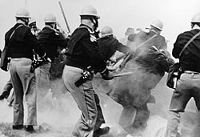
Bloody Sunday
Wikipedia

Selma to Montgomery marches
Wikipedia

Civil rights movement
Wikipedia

Selma, Alabama
Wikipedia

Alabama
Wikipedia

United States
Wikipedia

John Lewis
Wikipedia

Suffrage
Wikipedia

Marvelous Marvin Hagler
Wikipedia

Montgomery, Alabama
Wikipedia
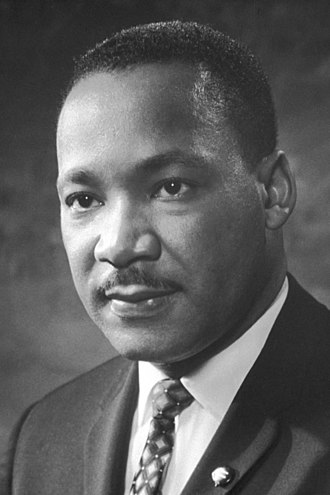
Martin Luther King Jr.
Wikipedia

George Wallace
Wikipedia

Tear gas
Wikipedia
Öffentliche Sicherheit
Wikipedia

Jimmy Carter
Wikipedia

Egypt
Wikipedia

Vietnam War
Wikipedia

Viet Cong
Wikipedia

أرماندو وولي
Wikipedia

حنان ترك
Wikipedia

السيد سعيد
Wikipedia

أحمد لوكسر
Wikipedia
كوكا (ممثلة)
Wikipedia

حمدي غيث
Wikipedia

نجيب الكيلاني
Wikipedia
What Else Happened on March 7
Antoninus Pius died after a peaceful twenty-three-year reign, leaving the Roman Empire to his adoptive sons, Marcus Aurelius and Lucius Verus. This transition e…
Rome got two emperors for the price of one when Marcus Aurelius refused to rule alone. His adoptive father Antoninus Pius had just died, and Marcus immediately …
The 80-year-old governor was reading poetry when the mob arrived demanding he become emperor. Gordian I hadn't sought power—African landowners rebelled against …

Emperor Constantine I issued an edict on March 7, 321, declaring the dies Solis, the day of the Sun, as a day of rest throughout the Roman Empire. Shops were to…
Macarius I refused to recant even as the emperor's guards dragged him from the council chamber. The Third Council of Constantinople had spent months debating wh…
Konrad III secured the German throne at Coblenz, backed by the papal legate Theodwin. This election formally launched the Hohenstaufen dynasty, initiating a cen…
Talk to History
Have a conversation with historical figures who witnessed this era. Ask questions, explore perspectives, and bring history to life.