

Luther Stands Firm: Diet of Worms Ignites the Reformation
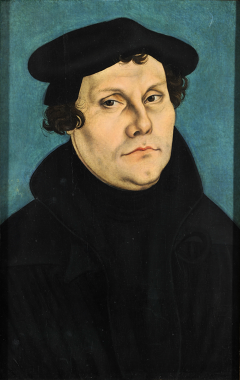
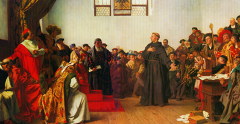
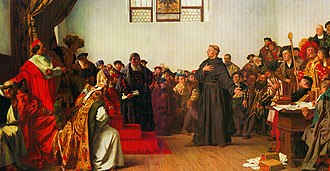
Martin Luther appeared before the Diet of Worms on April 17, 1521, summoned by Emperor Charles V to recant his writings. When asked if he stood by his books, Luther requested a day to consider. He returned on April 18 and delivered his famous refusal: "Unless I am convinced by the testimony of the Scriptures or by clear reason, I cannot and will not recant anything, for to go against conscience is neither right nor safe. Here I stand, I can do no other. God help me. Amen." The statement may be partially apocryphal, but its substance is confirmed by multiple witnesses. Charles V declared Luther an outlaw, but Frederick the Wise of Saxony staged a fake kidnapping and hid him in Wartburg Castle, where Luther translated the New Testament into German in 11 weeks.
April 17, 1521
505 years ago
Key Figures & Places
Lutheranism
Wikipedia
Martin Luther
Wikipedia
Diet of Worms
Wikipedia

Martin Luther
Wikipedia

Lutheranism
Wikipedia
Diet of Worms
Wikipedia

Excommunication
Wikipedia

Catholic Church
Wikipedia

Worms (Alemania)
Wikipedia

Holy Roman Empire
Wikipedia

Pope Benedict XIV
Wikipedia

the view that the earth orbits the sun
Wikipedia

Charles V, Holy Roman Emperor
Wikipedia
What Else Happened on April 17
Vitellius claimed the Roman throne after his legions crushed Otho’s forces at the First Battle of Bedriacum. This victory ended the brief reign of the third emp…
A crown slipped off a dying king's head in 1080, but Harald III left behind a throne that felt like a trap for his nephew. Canute IV took over, not just to rule…
Hasan II fell to an assassin’s blade, extinguishing the Bavand dynasty’s seven-century hold over the Mazandaran region. This power vacuum allowed the rival Afra…
A single poisoned cup ended the Bavand rule in 1349. The ruler drank, choked, and died while his guards watched silently. Now the Afrasiyab family seized the th…
Teutonic knights breached the walls of Kaunas Castle after a brutal month-long siege, capturing the Lithuanian stronghold and seizing its commander, Vaidotas. T…
A poet named Chaucer didn't just read to King Richard II; he gambled his reputation on a ragtag group of pilgrims in 1397. While the court dined, Chaucer introd…
Talk to History
Have a conversation with historical figures who witnessed this era. Ask questions, explore perspectives, and bring history to life.