

Rights of Man Declared: France's Revolutionary Dawn
The National Constituent Assembly adopted the Declaration of the Rights of Man and of the Citizen on August 26, 1789, six weeks after the storming of the Bastille. Drafted primarily by the Marquis de Lafayette with input from Thomas Jefferson, who was serving as American ambassador in Paris, the document declared that "men are born and remain free and equal in rights." It established freedom of speech, freedom of religion, the presumption of innocence, and the principle that sovereignty resides in the nation rather than the king. The declaration became the preamble to the French Constitution of 1791 and directly influenced the Universal Declaration of Human Rights in 1948. Women were excluded; Olympe de Gouges wrote a parallel declaration for women in 1791 and was guillotined.
August 26, 1789
237 years ago
Key Figures & Places

Palace of Versailles
Wikipedia

national assembly
Wikipedia
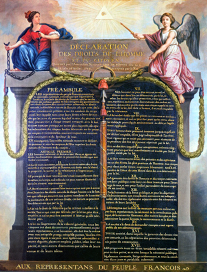
Declaration of the Rights of Man and of the Citize
Wikipedia

Declaration of the Rights of Man and of the Citizen
Wikipedia

France
Wikipedia
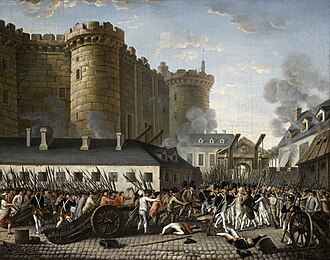
French Revolution
Wikipedia

National Constituent Assembly
Wikipedia

National Assembly (France)
Wikipedia

Jacques Chirac
Wikipedia

Valéry Giscard d'Estaing
Wikipedia

Marrakesh
Wikipedia
What Else Happened on August 26
Yazid I’s Syrian army crushed the Medinan resistance at the Battle of al-Harrah, slaughtering thousands of the city’s inhabitants and soldiers. This brutal vict…
Seljuq Turks shatter the Byzantine army at Manzikert, seizing control of most of Anatolia within a generation. This military collapse forces the Byzantine Empir…
Alp Arslan’s Seljuk forces crushed the Byzantine army at Manzikert, capturing Emperor Romanos IV Diogenes on the battlefield. This collapse shattered Byzantine …
Ottokar II of Bohemia had built the largest kingdom in Central Europe over thirty years of war, diplomacy, and inheritance. He controlled Bohemia, Austria, Styr…
The Rajput fortress of Chittorgarh fell to Alauddin Khalji's Delhi Sultanate army in 1303 after an eight-month siege, leading to one of the first recorded insta…
Chittorgarh had walls 22 kilometers long and held some of the most formidable fortifications on the Indian subcontinent. It fell to Ala ud-Din Khilji in 1303 af…
Talk to History
Have a conversation with historical figures who witnessed this era. Ask questions, explore perspectives, and bring history to life.