

La Rochelle Falls: Richelieu Crushes Huguenot Fortress
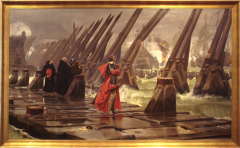
The siege of La Rochelle lasted 14 months, from September 1627 to October 28, 1628. Cardinal Richelieu built a 1,500-meter sea wall across the harbor to prevent English ships from resupplying the city. The fortification was an engineering feat: constructed on foundations sunk into the harbor floor, it blocked all maritime access. Inside the walls, the population of 27,000 starved. Dogs, cats, horses, leather, and grass were consumed. By the time the city surrendered, fewer than 5,000 inhabitants remained alive. Richelieu allowed the survivors to keep their Protestant faith but stripped the Huguenots of their military and political rights. La Rochelle's fall ended the Huguenots as an independent political force in France and consolidated royal power under Louis XIII, exactly as Richelieu intended.
October 28, 1628
398 years ago
Key Figures & Places
What Else Happened on October 28
The Praetorian Guard forced Emperor Nerva to adopt Trajan as his heir. Nerva was 66 and childless. The Guard had murdered his predecessor. They wanted a militar…
Maxentius declared himself Roman Emperor after his father's failed comeback attempt. The Praetorian Guard backed him. Rome's citizens backed him. The actual emp…

Constantine's army faced Maxentius at the Milvian Bridge over the Tiber on October 28, 312, outnumbered by perhaps three to one. Ancient sources claim Constanti…
Visigothic forces sacked Braga, capital of the Suevi kingdom in northwest Iberia. They burned the city's churches to the ground. The Suevi had converted to Cath…
Byzantine general Michael Bourtzes scaled Antioch's walls at night with a small force and seized two towers. The city had been in Arab hands for 340 years. Bour…
Byzantine forces recaptured Antioch in 969 after 333 years of Arab rule. Emperor Nikephoros II Phokas sent his best general, Michael Bourtzes, who climbed the w…
Talk to History
Have a conversation with historical figures who witnessed this era. Ask questions, explore perspectives, and bring history to life.