

Historical Figure
Catherine the Great
1729–1796
Empress of Russia from 1762 to 1796
Talk to Catherine the Great
Have a conversation with this historical figure through AI
Biography
Catherine II, commonly known as Catherine the Great, was the reigning Empress of Russia from 1762 to 1796. She came to power after a coup d'etat against her husband, Peter III. Her long reign helped Russia thrive under a golden age during the Enlightenment. This renaissance led to the founding of many new cities, universities, and theatres, along with large-scale immigration from the rest of Europe and the recognition of Russia as one of the great powers of Europe.
In Their Own Words (5)
I like to praise and reward loudly, to blame quietly.
As quoted in The Historians' History of the World (1904) by Henry Smith Williams, p. 423 , 1904
The Governing Senate. . . has deemed it necessary to make known... that the landlords' serfs and peasants . . . owe their landlords proper submission and absolute obedience in all matters, according to the laws that have been enacted from time immemorial by the autocratic forefathers of Her Imperial Majesty and which have not been repealed, and which provide that all persons who dare to incite serfs and peasants to disobey their landlords shall be arrested and taken to the nearest government office, there to be punished forthwith as disturbers of the public tranquillity, according to the laws and without leniency. And should it so happen that even after the publication of the present decree of Her Imperial Majesty any serfs and peasants should cease to give the proper obedience to their landlords . . . and should make bold to submit unlawful petitions complaining of their landlords, and especially to petition Her Imperial Majesty personally, then both those who make the complaints and those who write up the petitions shall be punished by the knout and forthwith deported to Nerchinsk to penal servitude for life and shall be counted as part of the quota of recruits which their landlords must furnish to the army. And in order that people everywhere may know of the present decree, it shall be read in all the churches on Sundays and holy days for one month after it is received and therafter once every year during the great church festivals, lest anyone pretend ignorance.
Decree on Serfs (1767) as quoted in A Source Book for Russian History Vol. 2 (1972) by George Vernadsky , 1767
A great wind is blowing, and that gives you either imagination or a headache.
As quoted in Daughters of Eve (1930) by Gamaliel Bradford, p. 192 , 1930
I will live to make myself not feared.
As quoted in The Historians' History of the World (1904) by Henry Smith Williams, p. 423 , 1904
Assuredly men of merit are never lacking at any time, for those are the men who manage affairs, and it is affairs that produce the men. I have never searched, and I have always found under my hand the men who have served me, and for the most part I have been well served.
As quoted in Woman Through the Ages (1908) by Emil Reich, p. 155 , 1908
Timeline
The story of Catherine the Great, told in moments.
Born Princess Sophie in Stettin, Prussia. Minor German nobility. Obscure family. Her mother drags her to Russia as a teenager to marry the heir to the throne.
Marries Grand Duke Peter, the future Peter III. He's immature, possibly impotent, obsessed with toy soldiers. She converts to Russian Orthodoxy, learns Russian, reads Voltaire and Montesquieu, and waits.
Overthrows her husband in a coup backed by the Imperial Guard. Peter III has been emperor for six months. He's alienated the army and the church. He signs his abdication. A week later he's dead. Officially from "hemorrhoidal colic." No one believes it.
Writes the Nakaz, a 526-article instruction for reforming Russian law, drawing on Montesquieu and Beccaria. She invites 564 deputies from across the empire to debate it. The commission meets for 18 months. The laws don't pass. But she's framed herself as an enlightened ruler, and Europe notices.
Annexes Crimea. The Ottoman Empire protests but can't stop her. She founds Sevastopol as a naval base. Russia now has a warm-water port on the Black Sea. The strategic geometry of Eastern Europe shifts permanently.
Dies of a stroke in St. Petersburg. She is 67. Thirty-four years on the throne. She expanded Russia by 200,000 square miles, founded over 100 new towns, and corresponded with Voltaire for 15 years. The salacious stories that survive her are almost entirely fabricated by enemies.
Artifacts (5)
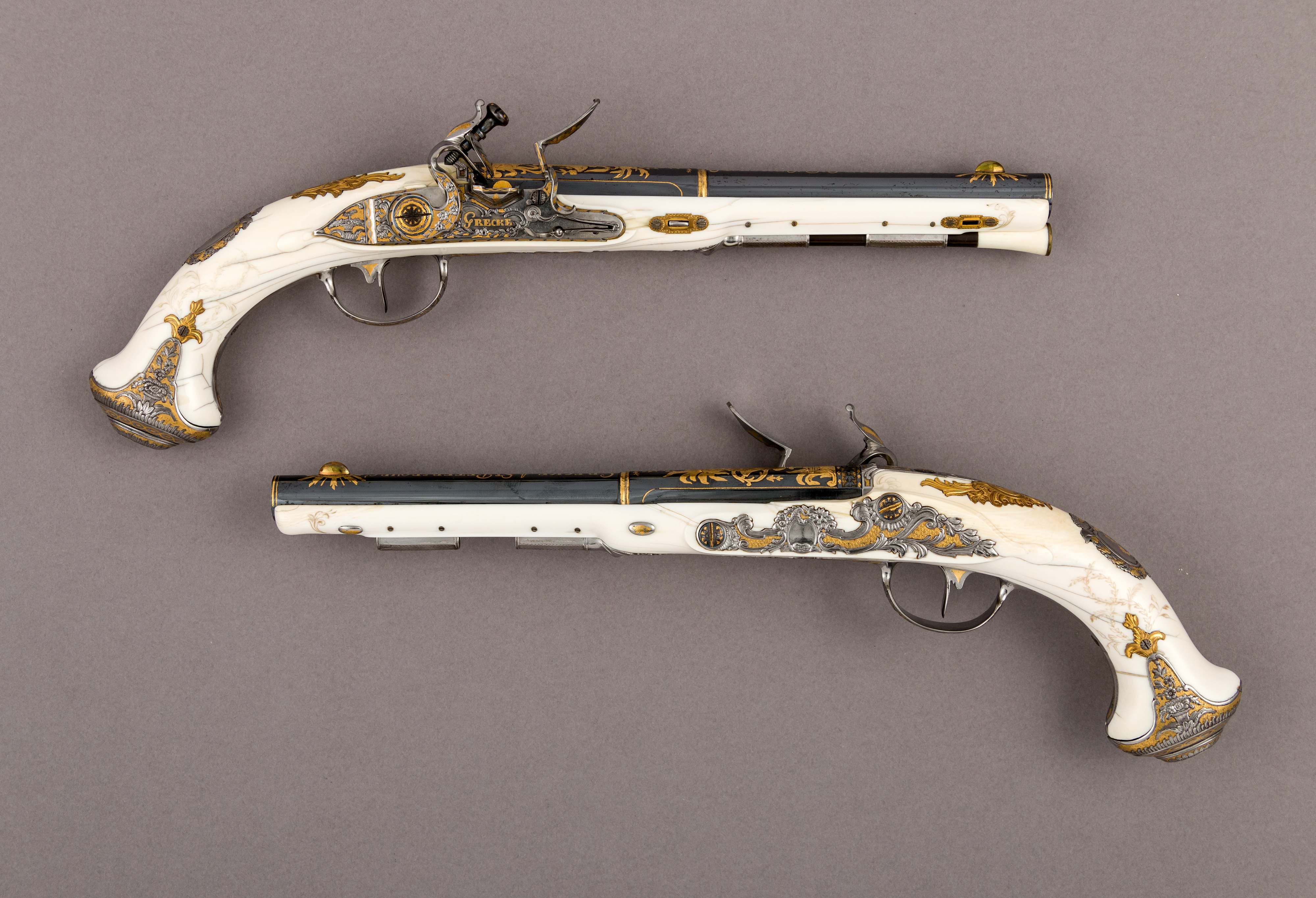
Pair of Flintlock Pistols of Empress Catherine the Great (1729–1796)
Johan Adolph Grecke
More from the Enlightenment


Explore what happened on the days that shaped Catherine the Great's life. Today In History connects historical figures with the events, births, and deaths that defined their era. Browse all historical figures or explore today's events.